I hope that readers of Hay Quaker will join me in a new venture, a blog about my views and experiences of simple living. Please Click here to see what I have been working on.
Some food for thought from a homesteading Quaker living in that beautiful part of Sweden called Småland.
Podcast Radical Simple Living
Showing posts with label Quaker views. Show all posts
Monday, November 17, 2014
Tuesday, January 8, 2013
Tuesday, December 18, 2012
Do my Forgiving ~ Mariellen O. Gilpin
"Sometimes forgiveness comes in an instant, an act of grace, as in the healing of my relationship with my father. Sometimes it comes in less deep-rooted relationships first, as in the challenges to my support group friends, because sometimes we have to grow stronger, wiser and more loving in other relationships first. Sometimes forgiveness must be a process, a progressive letting-go over time. But I need to forgive because it heals me physically as well as spiritually. I need always to challenge in the presence of God because of the resulting sense of compassion and wider vision. I need to remember the importance of humility, and the importance of not waiting for the other to change to do my forgiving. Always, I need to remember that the work of forgiveness is something God calls me to do."
Mariellen O. Gilpin
More at http://fqa.quaker.org/fager/gilpin.html
Artwork Ra;lph Chesse http://www.chesseartsltd.com/ralphchesse.html
Thursday, November 29, 2012
Trying to be Humble ~ Bruce Arnold
"I gradually moved away from the emphasis on plainness, and back to calling it simplicity. What I had learned, stayed with me, but the perspective underwent a gradual and subtle shift.Now, thirty years later, I am wondering about the wisdom of that. Many Friends are once again feeling the call to plainness.
First, I want to say that my suspicion that it takes community to have a real, vital expression of plainness is proving to be accurate. It may be, in our current situation, that this community is more “virtual” than was possible before. People who might never have met can now, through internet social networking media, question each other, support each other, serve as role models for each other. As this discussion grows, and more people engage with the effort, I expect that actual (or “analog”) communities will grow, in which people in the same Yearly Meetings (and not just the Conservative ones), or even the same local Meetings, will be practising plainness together, face to face and not just keyboard to keyboard......
What is plainness, then, and why is it different from simplicity? I am struggling to answer this question, myself. While I find it useful to distinguish the two, it is hard to come up with a pat definition that can withstand all objections.I know this, though: plainness has more to do with trying to be humble than it does with trying to be good."
Bruce Arnold
More from ~ http://lettersfromthestreet.wordpress.com/2012/03/04/quaker-plain-i/
Artwork from Matthew Hopkins http://www.matthewhopkinsart.com/
First, I want to say that my suspicion that it takes community to have a real, vital expression of plainness is proving to be accurate. It may be, in our current situation, that this community is more “virtual” than was possible before. People who might never have met can now, through internet social networking media, question each other, support each other, serve as role models for each other. As this discussion grows, and more people engage with the effort, I expect that actual (or “analog”) communities will grow, in which people in the same Yearly Meetings (and not just the Conservative ones), or even the same local Meetings, will be practising plainness together, face to face and not just keyboard to keyboard......
What is plainness, then, and why is it different from simplicity? I am struggling to answer this question, myself. While I find it useful to distinguish the two, it is hard to come up with a pat definition that can withstand all objections.I know this, though: plainness has more to do with trying to be humble than it does with trying to be good."
Bruce Arnold
More from ~ http://lettersfromthestreet.wordpress.com/2012/03/04/quaker-plain-i/
Monday, November 5, 2012
Collective Wisdom ~ Max Carter
"A notable aspect of Amish society is the ability to take new technologies and ideas, put them “on probation” to see how they affect core principles, and then make an informed decision about whether to adopt them. We modern Quakers are more prone to accept whatever new thing is coming down the pike, realizing only later that we should have been more careful in welcoming Trojan horses into our lives.......
How may we more effectively use the collective wisdom of our heritage and our community to assure that we march into the future wisely?"
~ Max Carter
More of this article at http://www.friendsjournal.org/are-you-amish/
How may we more effectively use the collective wisdom of our heritage and our community to assure that we march into the future wisely?"
~ Max Carter
More of this article at http://www.friendsjournal.org/are-you-amish/
Monday, October 22, 2012
Moderate Living ~ Aotearoa/New Zealand Quakers
"Simplicity does not consist in following a strict formula, but in basing our choice of purchases, activities and lifestyles on moderation rather than extravagance. Moderate living avoids over-indulgence and slavery to fashion; it requires a responsible attitude to alcohol and drugs of any kind. Children and young people are under particular pressure to acquire, consume and do what is fashionable or aggressively advertised. Adults can help children to develop inner strength by their own example, and by working out together what is right and possible, given the family's circumstances. Simplicity has its own beauty. It does not exclude artistic creativity, which is a deep human need, and can be an expression of the divine. Quakers look for an inner stillness in worship and in personal spiritual life, and a simplicity which lets go of inessential commitments in order to be truly centred."
~ Aotearoa/New Zealand Quakers
Artwork fom Clare Curtis http://clarecurtis.co.uk/
~ Aotearoa/New Zealand Quakers
More at http://quaker.org.nz/
Artwork fom Clare Curtis http://clarecurtis.co.uk/
Sunday, January 8, 2012
A Place of Loving Friendship ~ Advices and Queries Quakers in Britain
"Do you recognise the needs and gifts of each member of your family and household, not forgetting your own? Try to make your home a place of loving friendship and enjoyment, where all who live or visit may find the peace and refreshment of God's presence."
More at http://www.quaker.org.uk/advices/26
Wednesday, January 4, 2012
First Month ~ Two Faces - Ray Lovegrove
Free Man In Powys: First Month ~ Two Faces: For some years I worked at a Quaker school, At the entrance (being a Quaker school it had no gates) was a sign with the name of the school...
Thursday, December 1, 2011
Free Man In Powys: Is it a Gift to be Simple? ~ Ray Lovegrove
Free Man In Powys: Is it a Gift to be Simple?: It is a dingy South London classroom, sometime in the past - my past. In the room are at least two people; one of them is Miss O’Keefe, my ...
Thursday, November 17, 2011
The Tree Quaker ~ Ray Lovegrove
Free Man In Powys: The Tree Quaker: For some people, the great spiritual highs of their lives (apart from those “once in a while” things like graduating, getting married, havi...
Friday, November 11, 2011
About Tages ~ Ray Lovegrove
Free Man In Powys: About Tages: It’s November - not the most inviting month of the year. How is it that some months last longer than others? I know that some have thirty d...
Thursday, November 3, 2011
Beating the Clock ~ Ray Lovegrove
Free Man In Powys: Beating the Clock: It is no longer summer, fairly soon it will be no longer autumn either and the winter will be upon us. People prepare for the change in se...
Thursday, October 27, 2011
The New Digger ~ Ray Lovegrove
Free Man In Powys: The New Digger: It has not been a great year for weather here in Powys, and as a self-sufficient grower, I can say that it has been an awful year for growin...
Monday, July 11, 2011
Purpose in Living ~ Duane Elgin
"Because simplicity has as much to do with each person's purpose in living as it does with his or her standard of living, it follows that there is no single, 'right and true' way to live more ecologically and compassionately.
Although there is no dogmatic formula for simpler living, there is a general pattern of behaviour and attitudes that is often associated with this approach to living. Those choosing a simper life:
- Tend to invest time and energy freed up by simpler living in activities with their partner, children and friends (walking, making music together, sharing a meal, camping, etc.), or volunteering to help others, or getting involved in civic affairs to improve the life of the community.
- Tend to work on developing the full spectrum of their potentials: physical (running, biking, hiking, etc.), emotional (learning the skills of intimacy and sharing feelings in important relationships), mental (engaging in lifelong learning by reading, taking classes, etc.), and spiritual (learning to move through life with a quiet mind and compassionate heart).
- Tend to feel an intimate connection with the earth and a reverential concern for nature. In knowing that the ecology of the earth is a part of our extended "body," people tend to act in ways that express great care for its well-being.
- Tend to feel a compassionate concern for the world's poor: a simpler life fosters a sense of kinship with people around the world and thus concern for social justice and equity in the use of the world's resources.
- Tend to lower their overall level of personal consumption - buy less clothing (with more attention to what is functional, durable, aesthetic, and less concern with passing fads, fashions, and seasonal styles), buy less jewellery and other forms of personal ornamentation, by fewer cosmetic products and observe holidays in a less commercialized manner.
- Tend to alter their patterns of consumption in favor of products that are durable, easy to repair, non-polluting in their manufacture and use, energy-efficient, functional and aesthetic.
- Tend to shift their diets away from highly processed foods, meat, and sugar toward foods that are more natural, healthy, simple, and appropriate for sustaining the inhabitants of a small planet.
- Tend to reduce undue clutter and complexity in their personal lives by giving away or selling those possessions that are seldom used and could be used productively by others (clothing, books, furniture, appliances, tools, etc.) Tend to use their consumption politically by boycotting goods and services of companies whose actions or policies they consider unethical.
- Tend to recycle metal, glass, and paper and to cut back on consumption of items that are wasteful of non-renewable resources. Tend to pursue a livelihood that directly contributes to the well-being of the world and enables a person to use more fully his or her creative capacities in ways that are fulfilling.
- Tend to develop personal skills that contribute to greater self-reliance and reduce dependence upon experts to handle life's ordinary demands (for example, basic carpentry, plumbing, appliance, repair, gardening, crafts, etc.)
- Tend to prefer smaller-scale, more human-sized living and working environments that foster a sense of community, face-to-face contact, and mutual caring.
- Tend to alter male-female roles in favor of non-sexist patterns of relationship.
- Tend to appreciate the simplicity of nonverbal forms of communication - the eloquence of silence, hugging and touching, the language of the eyes.
- Tend to participate in holistic health-care practices that emphasize preventative medicine and the healing powers of the body when assisted by the mind.
- Tend to involve themselves with compassionate causes, such as protecting rain forests and saving animals from extinction, and tend to use non-violent means in their efforts.
- Tend to change transportation modes in favour of public transportation, car-pooling, smaller and more fuel-efficient autos, living closer to work, riding a bike and walking.
Because there is a tendency to emphasis the external changes that characterize simpler living, it is important to reiterate that this approach to life is intended to integrate both inner and outer aspects of existence into a satisfying and purposeful whole."
Thursday, May 26, 2011
Life Itself ~ Kathryn Damiano
"We have to be reminded that spirituality is not a separate compartment of life, but life itself and what is ordinary is the major part of our lives .... Ordinariness can be radical: it gets to the root of knowing God in everyday life."
Kathryn Damiano, 1996
More at http://www.quakerinfo.com/silence.shtml
Artwork from Linda Farquharson http://www.linocut.co.uk/
Thursday, January 27, 2011
Keep the Knowledge Clear ~ Frances Irene Taber
"It may surprise some of us to hear that the first generation of Friends did not have a testimony for simplicity. They came upon a faith which cut to the root of the way they saw life, radically reorienting it. They saw that all they did must flow directly from what they experienced as true, and that if it did not, both the knowing and the doing became false. In order to keep the knowledge clear and the doing true, they stripped away anything which seemed to get in the way. They called those things superfluities, and it is this radical process of stripping for clear-seeing which we now term simplicity."
~ Frances Irene Taber, 1985
More at http://www.flickr.com/photos/iowayoders/galleries/72157623798810025
~ Frances Irene Taber, 1985
Wednesday, November 17, 2010
Quakers and Native Americans ~ George R. Fisher
"Quakers have a long history of greater sympathy with Indian tribes than most other white settler groups. So it is not surprising that the standing committee on Indian Affairs of the Philadelphia Yearly Meeting, first appointed in 1795, has endorsed the United Nations Declaration on the Rights of Indigenous Peoples, and persuaded the annual Meeting as a whole to adopt it as well. It is furthermore not surprising that over a hundred nations within the U.N. have also adopted the Declaration. What is disconcerting is that the United States, Canada and New Zealand have declined to endorse it."
Friday, November 12, 2010
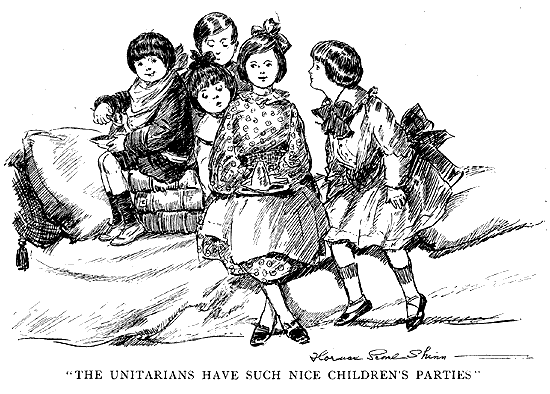
Quakers and Unitarians ~ Ray Lovegrove
Friends place a great deal of importance in the simple, age old process of shaking hands. At the end of Meeting you may shake hands with an old acquaintance, or a complete stranger, it depends on who's sitting close to you, that's the very best reason for doing it! Should we not, as a group 'Quakers' take time to shake hands with other religious groups that share at least some things with us? Are some other churches close enough to our values to sit with us and share with us? Are their more opportunities for joint action on social issues and can we draw inspiration from religious heritages other than our own?
Looking for possible 'common ground' two churches seem to have potential as natural allies.The Mennonite Church sits close to us, we share a long history of non-aggression, opposition to war and peaceful resistance with them and many other factors of common heritage. Friends should have no problem in looking fondly at Mennonite communities and accepting the differences, as well as the similarities in a spirit of love and co-operation. On the other side of us sit the Unitarian Universalists. True, some Friends would have more in common with them than others but, they do share much of our concern with putting faith into action for social good and we are both 'broad churches' which not only tolerate, but positively celebrate diversity in our respective memberships.
In the UK Friends and Unitarians have a good tradition of co-operation in fields of same-sex marriage campaigning and nuclear disarmament lobbying, while historically American Friends and Unitarians had a long tradition of co-operation in fields of women's suffrage and abolitionism with individuals like Susan B Anthony coming strongly to mind.
Looking for possible 'common ground' two churches seem to have potential as natural allies.The Mennonite Church sits close to us, we share a long history of non-aggression, opposition to war and peaceful resistance with them and many other factors of common heritage. Friends should have no problem in looking fondly at Mennonite communities and accepting the differences, as well as the similarities in a spirit of love and co-operation. On the other side of us sit the Unitarian Universalists. True, some Friends would have more in common with them than others but, they do share much of our concern with putting faith into action for social good and we are both 'broad churches' which not only tolerate, but positively celebrate diversity in our respective memberships.
In the UK Friends and Unitarians have a good tradition of co-operation in fields of same-sex marriage campaigning and nuclear disarmament lobbying, while historically American Friends and Unitarians had a long tradition of co-operation in fields of women's suffrage and abolitionism with individuals like Susan B Anthony coming strongly to mind.
The seven principles, which Unitarian Universalist congregations affirm and promote, would not find many Friends in disagreement I trust (please let me know if that's not the case). They are;
- The inherent worth and dignity of every person;
- Justice, equity and compassion in human relations;
- Acceptance of one another and encouragement to spiritual growth in our congregations;
- A free and responsible search for truth and meaning;
- The right of conscience and the use of the democratic process within our congregations and in society at large;
- The goal of world community with peace, liberty, and justice for all;
- Respect for the interdependent web of all existence of which we are a part.
- Direct experience of that transcending mystery and wonder, affirmed in all cultures, which moves us to a renewal of the spirit and an openness to the forces which create and uphold life;
- Words and deeds of prophetic women and men which challenge us to confront powers and structures of evil with justice, compassion, and the transforming power of love;
- Wisdom from the world's religions which inspires us in our ethical and spiritual life;
- Jewish and Christian teachings which call us to respond to God's love by loving our neighbours as ourselves;
- Humanist teachings which counsel us to heed the guidance of reason and the results of science, and warn us against idolatries of the mind and spirit.
- Spiritual teachings of earth-centered traditions which celebrate the sacred circle of life and instruct us to live in harmony with the rhythms of nature.
Before I upset any body let me say that I do not think that Friends should become Unitarian Universalists nor that Mennonites should become Quakers or that anybody move out of the tradition to which they belong and love and move to another. Let us, however, take the time to 'shake hands' with these groups and remind ourselves about what we might share in a spirit of love and understanding. Where possible, let us work with them to help attain our common goals. As a first move why not try to make 'friends' with Mennonites and Unitarian Universalists on social networking sites (many of both on Twitter) or you could even try shaking hands with those that you might just find in your neighbourhood!
I came upon this essay, by a Unitarian Pastor, about the differences between Quakers and Unitarians and found much to think about in it; please give it some time.
~
"There is a story told about Martin Luther when he was a young preacher. Luther used to write out his sermon and then read the text to the congregation. One day, a man approached Luther and said, “You shouldn’t preach from a prepared text. Instead you should simply go up into the pulpit and let the Spirit speak through you.” Martin Luther replied, “I did that once. I went up to the pulpit and I heard the spirit say, ‘Martin Luther you should have prepared a sermon.’ ”
"It might seem odd to begin a talk about Quakers and Unitarian Universalists with a story about Martin Luther, the founder of the Lutheran church. But I think the story helps to illustrate one of the differences between Unitarian Universalists and Quakers. The early Quakers were like the man who challenged Luther. They wanted their sermons to be spirit filled, straight from the heart and without a prepared text. Early Unitarians and Universalists (and certainly modern ones) would have more sympathy with Luther’s approach to sermonizing. And one of the ways you can tell I’m a Unitarian Universalist is that I stand before you with a prepared text for this morning’s sermon. However, it is my hope that the spirit can speak through a prepared presentation also. And that this talk about Quakers and Unitarian Universalists will in some sense help to deepen our spiritual as well as our intellectual lives."
More about Mennonites;
More about Unitarian Universalists;
Friday, November 5, 2010
Quakers and Same Sex Relationships
"...22 years after the prospect was first raised at Meeting for Sufferings we are being led to treat same sex committed relationships in the same way as opposite sex marriages, reaffirming our central insight that marriage is the Lord’s work and we are but witnesses. The question of legal recognition by the state is secondary."
Minute 25, Britain Yearly Meeting 31 July 2009
Sunday, October 24, 2010
Quakers and Sexuality ~ Britain Yearly Meeting
Quakers were one of the first churches to talk openly about sexuality. Since we try to live our lives respecting 'that of God' in everyone we would want to treat all people equally. We feel that the quality and depth of feeling between two people is the most important part of a loving relationship, not their gender or sexual orientation.
Britain Yearly Meeting
Subscribe to:
Comments (Atom)
Click (below) and Discover
~ Ron Franscell
A.E. Housman
Adrian Fisher
Advices and Queries
Ageing
Agnes L. Tierney
Albert E. Day
Aldo Leopold
Aleksandr Solzhenitsyn
Alexie Torres-Fleming
Alice Reinheimer
Alice Stokes Paul
Alice Walker
Alone
Amish
André Kostelanetz
Andrew Cohen
Animals
Ann Barnes
Ann Preston
Anna Sewell
Anthony T. Hincks
Antoine de Saint-Exupéry
Arnold Bennett
Arnold Mitchell
Art
Arthur Gish
Arthur Miller
Ashley Wilcox
Autumn
Baltimore Yearly Meeting
Basil the Great
Ben Pink Dandelion
Benjamin Franklin
Benjamin Spock
Bernard Canter
Bernard of Clairvaux
Betty Friedan
Bhagwan Shree Rajneesh
Bill McKibben
Bill Mollison
Bob Dylan
Bob Marley
Boris Pasternak
Britain Yearly Meeting
Bruce Arnold
Bruderhof
C.S. Lewis
Caitriona Reed
Carl Honoré
Carol Deppe
Carol Holst
Caroline Stephen
Celtic Wisdom
Charles Dudley Warner
Charles E. Kellogg
Charles H. Spurgeon
Charlie Chaplin
Charlotte Brontë
Chellie Pingree
Children
Ching Ning Chu
Christina Rossetti
Christopher Bamford
Christopher Morley
Claudio Oliver
Comments about Quakers
Community
Conflict
Contemplative Scholar
Corita Kent
Craig Barnett
Craig Jensen
Creation
Creativity
D H Lawrence
D. H. Lawrence
Dag Hammarskjold
Daniel Stulac
Daniele Varè
David Attenborough
David J. Clark
Dean Ornish
Death
Dennis Kucinich
Derek Walcott
Desmond Tutu
Dinah Craik
Dinah Maria Mulock Craik
Diversity
Donald B. Kraybill
Donald Soper
Donna Tartt
Dora Willson
Doris Lessing
Dorothy L. Sayers
Dorothy Law Nolte
Dostoyevsky
Douglas V. Steere
Duane S. Elgin
E. B. White
E. F. Schumacher
E. Nesbit
E.F. Schumacher
E.F. Schumacher. Green wisdom
Eberhard Arnold
Ed Begley Jr
Edna St. Vincent Millay
Education
Edward Abbey
Edward Bulwer-Lytton
Edwin Way Teale
Elise Boulding
Elizabeth Bathurst
Elizabeth Berg
Elizabeth Fry
Elizabeth Goudge
Elizabeth Kubler-Ross
Elizabeth Marshall Thomas
Elizabeth Watson
Ellen M. Ross
Elsie Boulding
Emil Fuchs
Emily Greene Balch
Eugene O'Neill
Eve Balfour
Evelyn Sturge
Evelyn Underhill
F. Scott Fitzgerald
Faith
Faith Baldwin
Fall
Family Life
Family lLife
Farming
Faults
Fear
Food
Forgiveness
Forgivingness
Francis Brown
Francis de Sales
Francis Howgill
Frank Zappa
Franz Winkler
Frederick Parker-Rhodes
Freedom
Friendship
Frugality
Fyodor Dostoyevsky
G. K. Chesterton
Gardening
Garrison Keillor
Gary Snyder
Geen Wisdom
Gene Logsdon
Geoffrey Durham
George Amoss Jr
George Bernard Shaw
George Fox
Gerard Manley Hopkins
Gert
Giovanni Boccaccio
Goethe
Grace Blindell
Gratitude
Green
Green Wisdom
Growing Grace Farm
Gustave Flaubert
H.G. Wells
Hal Borland
Hamlin Garland
Hannah Heinzekehr
Harriet Beecher Stowe
Haruki Murakami
Harvey Gillman
Hay Quaker
Health
Helen Fox
Helen Nearing
Henri Frederic Amiel
Henri Nouwen
Henri-Frédéric Amiel
Henry David Thoreau
Henry T. Hodgkin
Henry Van Dyke
Henry Wadsworth Longfellow
Henry Ward Beecher
Herb Walters
Herman Melville
Hermann Hesse
Hilda Clark
Home
Hope
Horace B Pointing
Howard H. Brinton
Humility.
Iris Graville
Iris Murdoch
Isaac Newton
Isaac Penington
Isabel Allende
Islamic Wisdom
J. Field
J.D. Belanger
Jack Kornfield
James D. Wilson
James Fenimore Cooper
James Fennimore Cooper
James Nayler
James Parnell
James Riemermann
James Thurber
Jan Struther
Jana Llewellyn
Jane Addams
Jane Austen
Jane Goodall
Janet Scott
Jean Toomer
Jean Webster
Jeanne Roy
Jennifer Kavanagh
Jenny Spinks
Jewish Wisdom
Jimmy Carter
Joel Salatin
Johann Christoph Arnold
John Dear
John Donne
John Dunston
John Everard
John Field
John Fowles
John Greenleaf Whittier
John Howard Yoder
John Lubbock
John Milton
John Muir
John Nicholson
John O'Donohue
John of Ruysbroeck
John Patrick Shanley
John Robbins
John Ruskin
John Seymour
John Steinbeck
John W Rountree
John William Grahamuaker Wisdom
John Wood
John Woolman
Jon Krakauer
Jonathan Edwards
Joni Mitchell
Josef Pieper
Joseph Brackett
Joseph Campbell
Joseph Conrad
Joshua Loth Liebman
Joy
Joy Clarkson
Kallistos Ware
Kathryn Damiano
Keith Stewart
Kenneth Boulding
Kenneth Grahame
Kent Nerburn
Kristen Boye
Kristin Kimball
L. Frank Baum
L.M. Montgomery
Larry McMurtry
Laura Ingalls Wilder
Leila Lees
Leo Tolstoy
Leonard Cohen
Leonardo da Vinci
Lewis Carroll
Leymah Gbowee
Little Falls Friends
Lois Rock
Lorna M. Marsden
Lorraine Anderson
Louisa May Alcott
Louise Dickinson Rich
Love
Lucy Maud Montgomery
M. Scott Peck
Madeleine L'Engle
Marcus Aurelius
Margaret Fell
Margaret Mead
Marie Curie
Mariellen O. Gilpin
Mark Birch
Mark Boyle
Mary J. Tabor
Masanobu Fukuoka
Matt Kinsi
Matthew Landis
Max Carter
May Sarton
Maya Angelou
Meister Eckhart
Melancholy Jane
Mennonite
Mennonite Wisdom
Michael Pollan
Michel de Montaigne
Mildred Tonge
Miriam Toews
Mohammed Faris
Monica
Muhammad Ali
Naomi King
Natalie Goldberg
Nathaniel Hawthorne
Nature
Neil Young
Nicolas Gallicus
Nikos Kazantzakis
Nilton Bonder
Non-violence.
Nonconformity
Norma Jacob
Norman Wirzba
Oliver Cromwell
Oscar Wilde
Pamela Haines
Parenting
Parker J. Palmer
Paul A. Lacey
Paul Lacey
Paul Newman
Paulo Coelho
Peace
Peace.
Pearl S. Buck
Pete Dunne
Philip Britts
Pierre Teilhard de Chardin
Piet Hein
Plainness
Pleasure
Poetry
Poetry.
Prayer
Primo Levi
Prison
Quaker action
Quaker history
Quaker Lives
Quaker Scientists
Quaker views
Quaker Wisdom
Quaker Women
Quiet
Rachel Carson
Rachel Sontag
Rainer Maria Rilke
Ray Bradbury
Ray Lovegrove
Rebecca James Hecking
Redeeming the Dirt
Renewal
Rhoda Janzen
Richard J Foster
Richard P. Feynman
Richard Proenneke
Richard Scatchard
Robert Barclay
Robert Browning
Robert Burns
Robert E. Lee
Robert E. Reuman
Robert Griswold
Robert Hart
Robert Louis Stevenson
Robert Maynard Hutchins
Robertson Davies
Roger Bartlett
Roger Scruton
Rudy Henry Wiebe
Rufus Jones
Rufus M. Jones
Sean Stewart.
Seasons
Self-sufficiency
Shakers
Shirley Williams
Silence
Simon Heywood
Simplicity
Slavery
Slow
Sm Keen
Soil
Solitude
Stephen Batchelor
Stephen Crisp
Stephen Jay Gould
Sterling Olmstead
Sue Bender
Susan B. Anthony
Susanne Kromberg
Sustainability
Sylvia Townsend Warner
T.H.White
Teresa of Avila
The Jones Family
The Northumbria Community
The Quaker Dharma
The Quaker Scholar
Thomas A' Kempis
Thomas Clarkson
Thomas de Quincey
Thomas Kelly
Thomas Moore
Thomas More
Thomas R. Kelly
Thomas Traherne
Thornton Wilder
Time
Tom Walsh
Tove Jansson
Trust
Truth
U.A. Fanthorpe
Ubantu
Unitarian Wisdom
Universal Wisdom
Universal; wisdom
Ursula Franklin
Vegetarian Wisdom
Veronica Nicholson
Victor Hugo
Victoria Pearson
Virginia Shurman
Virginia Woolf
W Ross Chapman
Walt Whitman
Walter James
War
Warren E. Burger
Wealth
Wee Dragon
Wendell Berry
Will Bonsall
Willa Cather
William Blake
William Charles Braithwaite
William George Jordan
William H. Sessions
William Henry Channing
William Law
William Leddra
William Penn
William Wordsworth
Willis D. Nutting
Winter
Wisdom
Wolf Mendl
Work
Worship